

What Commercial Tree Risk Assessment Covers
- barnabycoleman
- Jun 30
- 6 min read

A tree does not need to fail completely to become a serious site issue. A heavy limb over a car park, basal decay beside a footpath, or storm damage near a building can all create risk long before a tree comes down. That is why commercial tree risk assessment is not simply paperwork. It is a practical way to understand what is on your land, what level of risk it presents, and what action is genuinely needed.
For commercial sites, estates and public-facing land, the real challenge is balance. You need to protect people, property and site access, but you also need to avoid unnecessary work, retain healthy trees where possible, and show that decisions have been made responsibly. A sound assessment helps you do all three.
What a commercial tree risk assessment is for
At its core, a commercial tree risk assessment is a structured inspection of trees in relation to their condition, their surroundings and the likelihood of harm if something fails. It considers both the tree itself and the target beneath or around it. A mature beech in open ground may present a very different level of concern from the same tree over a school entrance or busy access road.
This matters because risk is never just about defects in isolation. Trees can contain cavities, deadwood or historic wounds and still be retained safely with the right management. Equally, a tree that appears broadly healthy may need prompt attention if recent construction damage, root disturbance or exposure changes have made it unstable.
For landowners, managing agents and facilities teams, the assessment also forms part of a sensible duty of care. It shows that trees have been considered by a competent professional, that obvious hazards are not being ignored, and that any recommended works are linked to observed site conditions rather than guesswork.
What is looked at during a commercial tree risk assessment
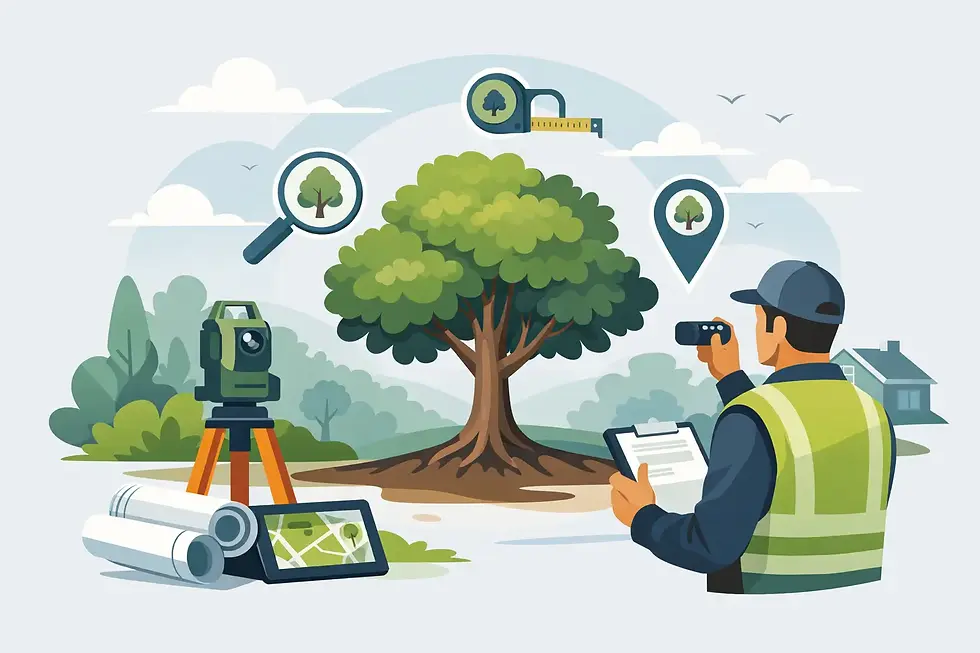
A proper inspection starts with the basics - species, age class, size, form and visible condition. From there, the focus shifts to structural integrity. An arborist will look for cracks, included bark unions, decay pockets, weak attachments, significant deadwood, root plate movement, fungal fruiting bodies and signs of stress in the canopy.
Context is just as important. The same defect can carry very different weight depending on occupancy and use. A tree near a playground, public footpath, office entrance, road, boundary wall or parking area needs to be judged against the frequency and nature of the target. On a lightly used part of a rural estate, the response may be less urgent than on a busy commercial frontage.
Ground conditions can also change the picture. Waterlogging, recent excavation, changes in soil level and repeated vehicle movement around the rooting area can all affect tree stability over time. In some cases, what appears to be a canopy problem is actually rooted in below-ground damage.
Where necessary, further investigation may be advised. That does not mean every tree needs advanced testing. Often, a competent visual inspection is enough. But if there are signs of concealed decay, uncertain structural weakness or important retention decisions to make, more detailed assessment can be the sensible next step.
Why commercial sites need a different approach
Commercial land is rarely straightforward. A domestic garden may involve one owner and a small number of trees. A business park, school, hotel grounds, churchyard, housing development or managed estate can involve mixed tree stock, varied public access, neighbouring property and multiple stakeholders.
That changes how inspections are planned and recorded. Trees may need to be prioritised by zone, use or occupancy. High-traffic areas usually warrant closer attention and more regular review than low-use boundaries or woodland edges. The objective is not to inspect everything in the same way. It is to apply a proportionate approach that reflects actual site use and foreseeable risk.
This is particularly relevant where trees contribute strongly to the setting and value of the site. Mature trees can frame entrances, soften hard landscaping, support biodiversity and preserve the character of historic grounds. Removing them simply to eliminate all possibility of failure is rarely the right answer. Good arboricultural advice weighs risk management against long-term landscape value and environmental responsibility.
Common findings and what they usually mean
Many clients expect an assessment to end in removal recommendations. In reality, that is often not the case. Deadwood removal, reduction of over-extended limbs, crown management, exclusion of traffic from a rooting area, or a programme of monitoring may be enough to reduce risk to an acceptable level.
Sometimes the best outcome is no immediate work at all. A tree may have minor defects that should be recorded and revisited, but not acted on straight away. That can be the most honest advice, especially where the tree is otherwise healthy and the target area is limited.
There are, of course, cases where urgent action is needed. Severe decay at the base, major storm damage, a hanging limb over a public route, or clear signs of instability can require prompt intervention. Even then, the response should be measured. It may be possible to make the tree safe and retain part of it for habitat, or to phase work in a way that protects both safety and site value.
How reports support compliance and decision-making
For commercial clients, a tree inspection is not only about what is seen on the day. It is also about having a clear record of what was inspected, what was found and what was recommended. If there is an incident, vague recollection is not enough.
A written record supports internal maintenance planning and helps organisations show that they are acting responsibly. It can also assist when reporting to trustees, governors, property committees, estates teams or insurers. In more complex settings, it provides a practical basis for prioritising works rather than reacting to the loudest concern or the most visible tree.
That record should be readable, not buried in jargon. The point is to give decision-makers confidence. If a recommendation is urgent, that should be clear. If it is precautionary or linked to longer-term monitoring, that should be clear too.
When to arrange a commercial tree risk assessment
The right timing depends on the site. Many organisations benefit from a scheduled inspection cycle, particularly where there is regular public access or a substantial tree stock. Other sites may need an assessment after a storm event, before development works, following a change in land use, or when specific defects have been noticed by staff or tenants.
Warning signs should never be ignored. Fresh cracks, heaving soil at the base, sudden leaning, large amounts of fallen branchwood, fungal growth around the stem base, or significant dieback in the canopy all justify closer inspection. The same applies if access patterns have changed and trees now stand over newly active routes, parking areas or outdoor seating.
In East Sussex, seasonal weather can add pressure in different ways. Dry periods can stress some trees and expose underlying weakness, while prolonged wet conditions and wind can test root stability and branch attachment. Local knowledge helps when judging how recent weather patterns may have affected a site.
The value of standards-based tree management
Tree risk assessment works best when it is part of a wider management approach rather than a one-off reaction. Recommendations need to be carried through properly, by suitably qualified professionals working to recognised standards. That matters for safety, but it also matters for the trees. Poorly specified or badly executed work can create new defects and shorten a tree's useful life.
For commercial clients, there is reassurance in using a contractor who understands both consultancy and practical tree surgery. It means the advice given on inspection is grounded in how trees respond to pruning, how defects behave over time, and what can realistically be achieved on site. BC Tree Services takes that approach, combining practical experience with clear, honest arboricultural guidance and work carried out in line with BS 3998:2010.
A good assessment should leave you with clarity, not alarm. You should know which trees need attention, which can be retained with confidence, and how to plan sensible next steps for the site as a whole. That is the real purpose of commercial tree risk assessment - not to create work for its own sake, but to help you manage land responsibly, safely and with proper respect for the trees that belong there.
If you are responsible for commercial grounds, estate land or public-facing property, the best time to address tree risk is before a concern becomes an incident.


Comments