
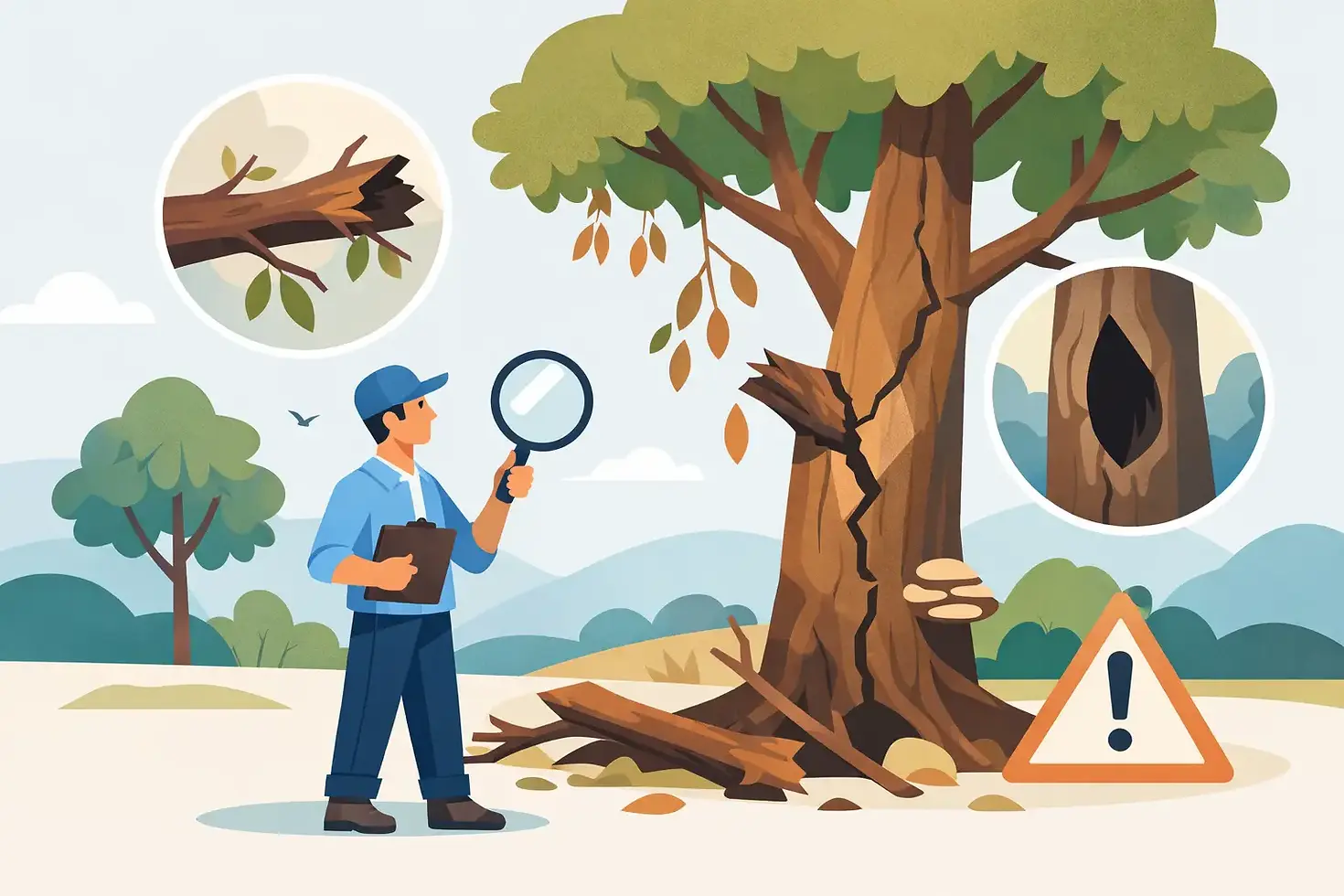
How to Spot Dangerous Trees Early

A tree rarely goes from healthy to hazardous overnight. More often, the warning signs build slowly - a crack that widens after winter, a lean that seems a little more pronounced, dead limbs that begin to appear in the crown. Knowing how to spot dangerous trees early can help you avoid property damage, disruption and, most importantly, serious safety risks.
Some defects are obvious. Others are easy to miss unless you know what you are looking for. A mature tree can still be valuable, stable and worth retaining even if it has a defect, but there are times when a problem points to structural weakness or decline that should not be ignored. The key is to look at the whole tree, not just one symptom in isolation.
How to spot dangerous trees from the ground
Most basic checks can be done safely from ground level. There is no need to climb, cut or disturb the tree. In fact, if a tree looks unstable, getting too close can be the wrong move.
Start with its overall shape. Has the tree changed noticeably in recent months or years? A tree that suddenly appears thin in the crown, heavily one-sided, or unusually sparse during the growing season may be under stress. Stress does not always mean immediate danger, but it can be a sign that the tree is struggling and more vulnerable to failure.
Then look at the stem and main limbs. Large cracks, splits, cavities and areas of missing bark deserve attention, especially if they sit where heavy limbs join the trunk or where the trunk forks into two large stems. These are common failure points. Fresh cracks are particularly concerning after strong winds or prolonged wet weather.
The base of the tree matters just as much as the crown. Soil movement, lifted ground, exposed roots or fungal growth around the root plate can indicate instability below the surface. A tree may still have a full canopy and yet be at risk if the root system has been compromised.
Warning signs that should never be ignored
Some features are stronger indicators of danger than others. Deadwood is a common example. A few small dead twigs in a mature tree are not unusual, but large dead branches, especially over a road, footpath, garden seating area or building, create a direct risk and should be assessed promptly.
A pronounced lean can also be significant, although context matters. Some trees naturally grow at an angle and remain stable for many years. The concern is a recent lean, a lean combined with cracked soil at the base, or a tree that appears to be shifting away from its original position.
Fungal fruiting bodies are another sign worth taking seriously. Brackets or clusters of fungus at the base, on exposed roots or on the trunk can suggest internal decay. That does not automatically mean the tree is unsafe, because some decayed trees can still stand for years, but the location and extent of decay are crucial. Internal wood strength cannot be judged by appearance alone.
Watch for bark that is peeling away in large sections, cavities that extend deep into the stem, and unions where two stems press tightly together with bark trapped between them. Known as included bark, this weak attachment can split under load.
What dangerous tree damage looks like after storms
Storms often reveal defects that were already present. High winds, saturated ground and snow loading all put added strain on weak trees and limbs. After severe weather, inspect trees near access routes, parking areas, boundaries and buildings before carrying on as normal.
Look for hanging branches, newly exposed wood, fresh tears where limbs have failed, and debris beneath the canopy. A branch that has partially broken but remains suspended is particularly dangerous. It may fall without warning and should be dealt with by a trained professional.
Also check whether the ground around the base has heaved or cracked. Root plate movement is one of the clearest signs that a tree may be failing. If the tree is close to a house, highway, public space or neighbouring land, urgent action is usually needed.
Tree species, age and condition all play a part
There is no single dangerous species, but some trees are more prone to certain defects than others. Fast-growing species may produce brittle limbs. Older trees may develop cavities or deadwood as part of the ageing process. Multi-stemmed trees can be attractive features, yet the unions between stems often need closer attention.
This is where experience matters. A hollow stem, for example, is not always a reason to remove a tree. Some veteran trees continue to stand safely with internal decay because the remaining wall of sound wood is sufficient. Equally, a tree that looks green and vigorous can still fail if a hidden defect affects the root system or a major union.
That is why dangerous trees are not judged on one feature alone. Arboricultural assessment is about condition, structure, target area and likelihood of failure taken together.
Signs of root problems and hidden instability
Root issues are among the most overlooked hazards because the damage is often out of sight. Construction work, changes in ground level, trenching, repeated vehicle loading and soil compaction can all weaken a tree over time. Even routine landscaping can create problems if roots are severed or buried.
Common warning signs include thinning foliage, premature leaf drop, dieback in the upper crown, fungal growth near the base and a tree that suddenly begins to lean. Sometimes the first visible symptom is poor vitality rather than obvious movement.
Waterlogged ground can add further pressure, particularly in clay soils or exposed sites. In parts of East Sussex, winter weather can leave trees standing in saturated ground for extended periods, increasing the risk of root instability in already stressed specimens.
When a tree is unsafe but not obviously dying
One of the biggest misconceptions is that only dead trees are dangerous. In practice, many hazardous trees still leaf up well. They may look healthy from a distance while carrying serious structural defects.
A limb can be overloaded, poorly attached or internally cracked despite producing normal foliage. A tree with a dense crown may actually catch more wind, increasing stress on weak points. Likewise, a vigorous tree can outgrow a defect, making the weight at the end of a compromised limb more significant over time.
This is why visual appearance can be misleading. Health and safety are related, but they are not the same thing.
When to call a professional arborist
If you are unsure, caution is the sensible choice. A qualified arborist can assess whether the issue is low risk, manageable through pruning, or serious enough to require more urgent work. They can also identify defects that are easy to miss from ground level and advise in line with recognised standards such as BS 3998:2010.
Professional advice is especially important if the tree is close to a public road, school, neighbouring property, overhead lines, parked vehicles or well-used parts of a garden. The consequences of getting it wrong are simply too high.
You should arrange an inspection promptly if you notice recent movement, major deadwood, significant cracking, root plate disturbance, fungal fruiting bodies at the base, or storm damage. If a tree has partially failed or looks as though it could collapse, keep clear and treat it as an emergency.
For homeowners and site managers, the aim is not to become an arborist overnight. It is to recognise when a tree has moved from being a feature of the landscape to a potential hazard that needs informed attention.
A sensible routine for checking trees
For most properties, a simple visual check a few times a year is enough to pick up obvious changes. Late winter is useful because branch structure is easier to see. Summer helps reveal thinning crowns and dead sections. After storms, an additional inspection makes sense.
Pay extra attention to trees near places people use every day - driveways, entrances, play areas, footpaths, garden offices and boundaries. Risk is never only about the tree itself. It is also about what sits beneath it.
Keeping a note of changes can help. If a crack was hairline last year and now appears wider, or if a lean has increased, that information is valuable when an arborist attends. It helps build a clearer picture of progression.
BC Tree Services regularly advises property owners on whether a tree needs monitoring, pruning, or more urgent intervention. Honest assessment matters, because not every defect calls for removal and not every mature tree with character is unsafe.
Trees add shape, shelter and long-term value to a landscape, but they do need watching. If something looks different, damaged or out of balance, trust that instinct and have it checked. Acting early is often the safest way to protect both the tree and the people around it.


Comments